
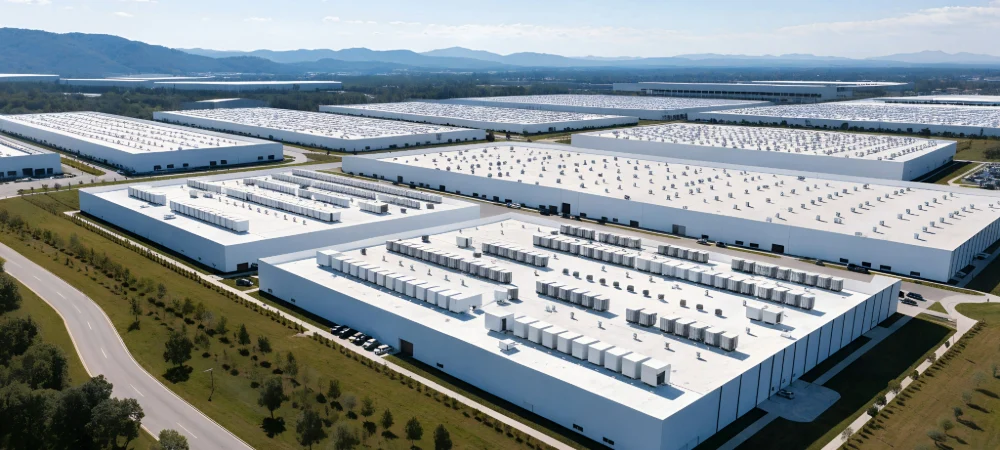
As hyperscalers, cloud providers and AI developers race to secure the computing capacity needed for increasingly sophisticated models, demand for facilities capable of housing, powering and cooling that infrastructure is accelerating at extraordinary speed.
Banks are becoming increasingly exposed to the global data centre boom as soaring demand for AI computing drives billions of dollars into new digital infrastructure, says Morningstar DBRS.
The scale of investment required to build, power and operate these facilities is creating significant financing opportunities while forcing lenders to confront growing concentration, credit and operational risks.
Morningstar DBRS estimates AI-related spending in the US reached around US$430 billion in 2025 and could more than double by 2029. Technology companies have already raised approximately US$300 billion from US investors and are increasingly turning to bank financing to support AI and data centre development.
For financial institutions, this represents a potentially lucrative new growth market. But the extraordinary amounts of capital being committed to AI infrastructure are also creating concentration, credit and operational risks that banks must manage carefully.
Data centre lending has become one of the fastest-growing areas of bank credit in recent years. Although exposures generally remain a relatively modest proportion of total loan portfolios, Morningstar DBRS says banks are increasingly relying on syndication, concentration limits, exposure caps, portfolio monitoring and risk-transfer mechanisms to prevent excessive exposure to the sector.
Banks move deeper into digital infrastructure
Banks’ exposure to data centres now extends across several areas of the financial system.
These include syndicated loans to developers, corporate lending to hyperscalers and infrastructure operators and structured finance transactions. Banks are also supporting the industry through mergers and acquisitions advice, debt arranging and equity capital markets transactions.
The enormous cost of developing modern AI infrastructure means financing is frequently arranged by banking syndicates capable of underwriting multibillion-dollar projects.
US banks remain among the dominant participants. JPMorgan, Goldman Sachs, Citigroup, Morgan Stanley and Wells Fargo have regularly arranged large financings for data centre developers and AI infrastructure projects.
The numbers illustrate the scale of the opportunity.
JPMorgan led a US$7.1 billion construction loan for Crusoe’s Stargate AI campus in Texas during 2025, while a consortium led by Morgan Stanley and MUFG provided US$2.6 billion in financing to CoreWeave later that year.
European institutions are also becoming increasingly active. Deutsche Bank provided €600 million of financing to Sweden-based EcoDataCenter in September 2025 and participated in AirTrunk’s AUD$4.3 billion financing in Australia alongside other lenders.
Meanwhile, private credit funds, infrastructure investors and asset managers are emerging as increasingly significant sources of capital. NVIDIA’s initiative to help mobilise more than US$500 billion for AI infrastructure demonstrates both the extraordinary investment requirements surrounding AI and the growing importance of nonbank finance.
For banks, the attraction is understandable. Data centres combine potentially long-term growth with enormous financing requirements and provide access to some of the world’s largest and most strategically important technology companies.
Banks can also generate revenue beyond conventional lending. Syndication and capital markets activities produce fees while allowing institutions to limit the amount of capital that remains on their balance sheets.
AI growth brings concentration risk
The opportunity, however, comes with a growing collection of risks.
One of the most important is concentration. Individual data centre projects can require billions of dollars of capital and frequently depend on a relatively small group of hyperscalers, AI companies or specialist infrastructure operators.
That means the apparent diversity of a rapidly expanding industry can mask significant underlying dependencies.
Hyperscalers accounted for approximately 59% of North American data centre tenant demand in 2026, according to market data cited by Morningstar DBRS. This makes customer concentration and counterparty exposure increasingly important considerations for lenders.
Credit risk is also tied closely to expectations about the future adoption of AI.
Today’s investment decisions frequently assume sustained growth in computing requirements and high utilisation of the infrastructure now being built. If commercial AI adoption develops more slowly than anticipated, utilisation rates and cash flows could fall below projections, potentially weakening borrowers’ ability to service debt.
This creates an unusual dynamic for lenders. Financing decisions being made today are partly dependent on assumptions about how extensively businesses and consumers will use AI several years from now.
Technology itself becomes a financial risk
Technology change creates another challenge.
Data centres are designed as long-term infrastructure assets, yet the technology they accommodate is evolving at extraordinary speed. Advances in semiconductor design, computing architectures and cooling systems could affect the competitiveness of existing facilities and require substantial additional investment.
The AI era is already reshaping data centre design. Higher-density computing requires greater power availability and increasingly sophisticated cooling technology, while developers must also secure sufficient grid capacity to support enormous electrical loads.
For lenders, this means assessing not only whether a facility can be constructed and leased successfully, but whether it can remain technologically and commercially relevant throughout the life of the financing.
There are more conventional infrastructure risks too.
Projects under development can face planning and permitting delays, construction problems, power connection constraints and cost inflation. Once operational, facilities depend on reliable and affordable electricity while revenue can be concentrated among a small number of tenants.
Energy price volatility and changing environmental regulations can therefore influence project economics and ultimately affect lenders.
Insurance is becoming another consideration, with higher premiums, tighter coverage conditions and reduced insurer capacity already affecting some large-scale data centre developments. Energy availability and physical security are also expected to remain significant as the industry expands.
Spreading billions of dollars of exposure
Banks are responding by finding increasingly sophisticated ways to distribute the risks associated with the data centre investment boom.
Syndication remains one of the most important mechanisms. Rather than retaining an entire loan, banks distribute portions among multiple lenders and investors, reducing the exposure of individual institutions.
The US$2.6 billion CoreWeave financing provides an example, with the exposure distributed across a large lending syndicate instead of being retained by a handful of lead arrangers.
Significant risk transfer transactions are another increasingly important tool. These structures enable banks to transfer portions of credit risk to external investors while maintaining relationships with borrowers and preserving lending capacity.
Loan sales and secondary market transactions can similarly reduce retained exposure, release capital and provide greater balance sheet flexibility.
As banks transfer more risk, private credit funds, insurance companies and infrastructure investors are consequently becoming more deeply embedded in the financing of digital infrastructure.
Securitisation moves into data centres
Securitisation is also becoming a more significant component of the market.
By packaging data centre loans into asset-backed securities (ABS) and related instruments, banks and infrastructure operators can transform relatively illiquid exposures into tradable securities while broadening the pool of investors financing the sector.
Vantage Data Centers completed the first EMEA data centre ABS transaction in 2024, raising £600 million through securitised notes. Switch issued US$1.7 billion of data centre ABS in 2024, followed by another US$3.5 billion of ABS and commercial mortgage-backed securities financing in 2025.
Such transactions demonstrate how the capital markets are increasingly being used to recycle investment and distribute data centre risk beyond conventional bank balance sheets.
That development is significant because the AI infrastructure boom may ultimately depend on the industry’s ability to tap a much broader pool of global capital.
Risk does not disappear
Moving exposure outside the banking sector does not, however, eliminate it.
Morningstar DBRS warns that risk-transfer mechanisms may introduce new vulnerabilities even as they improve capital efficiency and allow banks to continue financing AI infrastructure.
Strong investor appetite could potentially weaken underwriting discipline. At the same time, moving exposure from regulated banks towards nonbank financial institutions could reduce transparency and make it more difficult to determine where risks are accumulating across the financial system.
Regulators may consequently need to consider not only banks’ direct exposure to AI infrastructure, but how those risks are being redistributed through private credit, securitisation and other financial structures.
The result is a financial ecosystem becoming increasingly intertwined with the physical infrastructure underpinning AI.
Banks see an opportunity to finance one of the defining technology investment cycles of the decade. Developers need access to unprecedented amounts of capital and institutional investors are looking for exposure to an infrastructure sector supported by seemingly relentless demand for computing power.
Yet the same forces making data centres attractive also create risk. Projects are becoming larger, power requirements are rising, tenant concentration remains significant and assumptions about future returns increasingly depend on the continued expansion of AI.
Data centres may be powering the AI economy, but the financial architecture behind them is becoming almost as important as the technology housed inside their walls.

