
As AI and cloud computing scale across Europe, data centres face immense pressure to balance power density with sustainability. Brandon Smith, VP of Global Sales and Product, ZincFive, explores how nickel-zinc technology is emerging as a safer, more sustainable and high-performance alternative to traditional lead-acid and Lithium-Ion battery systems.

As cloud computing and AI rapidly expand across Europe, data centres are scaling at unprecedented speed. This growth is placing new pressure on regional power grids, many of which were not designed for the intensity and volatility of modern digital workloads. At the same time, European policymakers are accelerating sustainability mandates through initiatives such as the EU Battery Regulation, the Battery Passport framework and the revised Energy Efficiency Directive (EED). Together, these forces are reshaping how operators evaluate the technologies that power their critical infrastructure. Backup power systems – once considered a simple reliability safeguard – are now central to both operational resilience and environmental compliance. As scrutiny increases around safety, lifecycle emissions and circularity, the battery chemistry behind uninterruptible power supply (UPS) systems is becoming a strategic decision for data centre operators across Europe.
Legacy chemistries under growing pressure
For decades, lead‑acid batteries served as the standard solution for data‑centre backup power. Their long operating history, relatively low upfront cost and straightforward global transport made them a practical choice for early digital infrastructure. However, evolving environmental regulations are making this legacy chemistry increasingly difficult to justify. Policies such as the Waste Framework Directive and REACH regulations continue to tighten controls around hazardous materials, including lead. In addition, lead‑acid systems require large physical footprints, frequent maintenance and periodic replacement cycles that increase both operational disruption and lifecycle emissions. These factors ultimately raise the total cost of ownership while complicating environmental compliance.
Lithium-Ion batteries emerged as the modern alternative, largely due to their high energy density and longer lifespan compared with lead-acid systems. While Lithium-Ion technology has seen widespread adoption in consumer electronics and energy storage applications, considerations around safety and sustainability remain important in mission-critical environments. Thermal runaway events associated with Lithium-Ion systems have prompted increased industry focus on safety standards, system design and facility-level mitigation strategies. In addition, lithium extraction and processing present environmental challenges, while large-scale recycling infrastructure for Lithium-Ion batteries remains limited. As operators prepare to disclose lifecycle impacts under EU Battery Regulation (2023/1542) and manage Scope 3 emissions reporting requirements, the broader environmental footprint of Lithium-Ion systems is becoming increasingly visible.
Nickel‑zinc: A circular and responsible alternative
Against this backdrop, nickel‑zinc (NiZn) technology has emerged as a compelling alternative for modern UPS applications. NiZn batteries combine high power performance with strong sustainability credentials, aligning closely with Europe’s evolving regulatory priorities.
ZincFive’s nickel‑zinc chemistry relies on abundant and widely available materials that are significantly more common in the earth’s crust than lithium or lead. The batteries are composed of non‑toxic materials and are more than 90% recyclable, supporting circular‑economy objectives that are central to EU environmental policy. Lifecycle analysis shows that NiZn systems produce 25%-50% lower greenhouse‑gas emissions than comparable lead‑acid or Lithium‑Ion technologies, as validated by third-party analysis.
Water consumption is also dramatically reduced. From raw material extraction through end‑of‑life processing, nickel‑zinc batteries require approximately 96% less water than Lithium‑Ion systems. Combined with an operating life of up to 15 years – up to three times longer than many lead‑acid installations – NiZn solutions significantly reduce replacement cycles, waste generation and operational disruption. For operators balancing environmental compliance with financial discipline, these factors translate directly into lower lifecycle costs.
Safety and reliability for mission‑critical infrastructure
Safety remains one of the most critical considerations for data centre operators, particularly as facilities grow in size and density. Nickel‑zinc chemistry offers a significantly safer design compared with many Lithium‑Ion systems.
NiZn batteries use a non‑flammable aqueous electrolyte and operate without the risk of thermal runaway at the cell level. This design eliminates one of the most significant safety concerns associated with lithium‑based chemistries. The safety profile is further reinforced through UL 9540A testing, the industry benchmark for evaluating thermal runaway propagation and system-level safety performance in battery energy storage systems.
Operational resilience is equally important. ZincFive nickel‑zinc battery systems are engineered to remain functional even when individual cells degrade or become depleted, allowing the system to continue operating without catastrophic failure. This architecture helps maintain uptime and minimises service disruptions in mission‑critical environments.
Continuous innovation also plays an important role in advancing this technology. Improvements in cabinet materials, battery‑management systems and electrical protection mechanisms continue to enhance product longevity while reducing waste. This commitment to iterative engineering improvements ensures that performance, safety and sustainability evolve together over time.
Designed for the AI power era
The rapid rise of AI workloads is introducing new challenges for data centre power infrastructure. AI‑driven GPU clusters generate highly dynamic load profiles characterised by rapid spikes in power demand followed by sharp drops in utilisation. These fluctuations occur within milliseconds and can ripple through both facility power systems and the broader electrical grid.
Traditional battery chemistries were not designed for this level of rapid cycling. Lead‑acid and Lithium‑Ion systems often require infrastructure overbuild – additional batteries, cooling capacity and safety systems – to accommodate the demands of high‑frequency load fluctuations.
Nickel‑zinc chemistry is particularly well suited for these environments. NiZn batteries have industry-leading power density, which is a boon to power delivery and can discharge and recharge rapidly, enabling them to respond instantly to dynamic AI load profiles. With up to three times the power density of legacy chemistries and a footprint roughly half the size, NiZn systems allow operators to free valuable data centre floor space for revenue‑generating compute infrastructure.
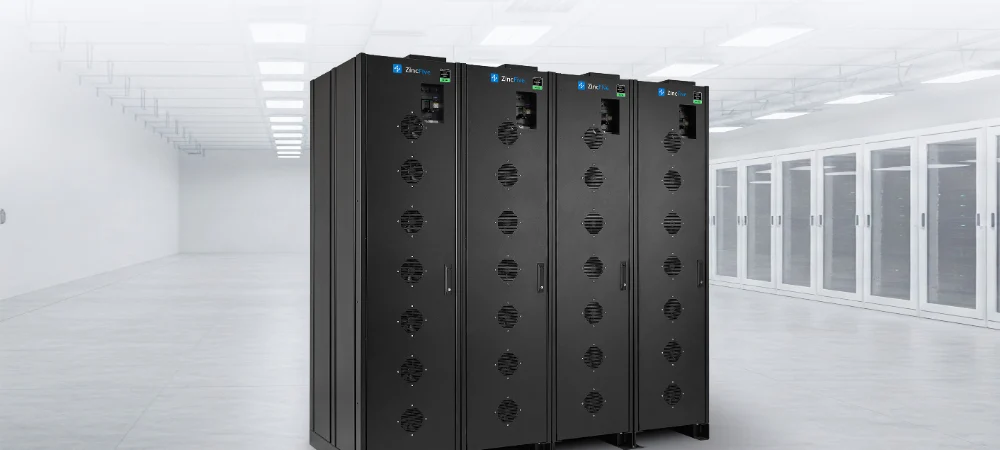
ZincFive’s BC 2 AI UPS Battery Cabinet exemplifies this approach. The system is designed to manage transient power fluctuations while also delivering reliable short‑duration backup power in a single modular architecture. This eliminates the need to combine multiple technologies to address different power requirements, reducing both complexity and material usage.
The sustainability benefits extend through the full lifecycle. The BC 2 AI cabinet is designed with a highly recyclable architecture and end‑of‑life material recovery offsets more than two metric tons of CO₂‑equivalent emissions per cabinet.
The path forward for Europe’s digital infrastructure
As Europe continues to expand its digital infrastructure and AI adoption accelerates, the region faces a critical challenge: delivering the power required to support innovation while meeting ambitious climate and sustainability targets.
Nickel‑zinc battery technology offers a path forward that aligns reliability, safety and environmental responsibility. ZincFive’s NiZn solutions are purpose‑built to respond to millisecond‑level power fluctuations without sacrificing lifespan or operational efficiency.
With almost 2 gigawatts (GW) of power shipped and contracted globally, nickel‑zinc technology is already proven in real‑world mission‑critical environments. For European operators navigating tightening regulations and rapidly evolving power demands, NiZn represents a compact, safe and future‑ready Immediate Power Solution for the next generation of data centres.

